
From Sample Approval to Mass Production: What to Agree First
An approved sample proves that the design can be made. It does not prove that the next two thousand units will match it. Between sample approval and mass production there are six things that must be agreed in writing, and most delays in a first order trace back to one of them being left to assumption.
The gap between a sample and a shipment is not a manufacturing gap; it is an information gap. A sample is usually built by the most experienced person on the line, using material from a small batch, with unlimited time for adjustment. Production is built by a team, from a bulk material order, against a delivery date. The two only match when the specification is precise enough to survive that change of conditions.
What the sample cannot tell you
A single sample cannot show you batch consistency. Wire arrives in coils from different heats, coating arrives in batches with slightly different gloss, and tube arrives with normal mill tolerances on wall thickness. None of this is visible in one unit, and all of it becomes visible across a container.
A sample also cannot show you tool wear. Jigs and fixtures shift as they are used, which is why the fiftieth unit and the five-hundredth unit can differ even when nothing else has changed. And it cannot show you how the product survives packing, because the sample was probably hand-carried rather than dropped, stacked and compressed the way a carton is in a container.
The six points to put in writing
First, tolerances. State the acceptable range for overall dimensions, bar spacing, wire diameter and tube wall thickness. A drawing with a nominal size and no tolerance is not a specification; it is a wish. Second, material. State the wire grade, the tube grade and the coating type, and require that any substitution be approved in writing before it is used.
Third, colour and finish. Coated product should be matched against a physical reference — a colour chip or the approved sample — not against a name on a purchase order. Names travel badly between languages, and "black" covers a wide range of gloss levels. Fourth, packaging. State the carton dimensions, the internal protection, the label position and the number of units per carton, because packaging is where landed cost is won or lost and where damage claims begin.
Fifth, inspection. Agree who checks what, at which stage, against which document. At minimum that means an incoming check on wire and tube, a weld check before coating, a dimensional check after assembly and a carton check before sealing. Sixth, the change process. Agree in writing that no change to material, dimension, hardware or finish may be made without written approval, and that any approved change resets the sample reference.
Who actually owns the specification
One question decides how smoothly a first order runs: whose document is the specification? If the answer is "the sample", there is no specification, only a shared memory that will diverge. If the answer is a drawing plus a written checklist that both sides have signed, the order has something to be measured against — including by a third party if it ever comes to that.
The practical arrangement is usually a buyer-owned specification with a supplier-confirmed drawing. The buyer states the requirements that matter to the market — dimensions, finish, packaging, labelling — and the supplier translates them into a manufacturing drawing, then confirms in writing that the drawing meets them. Both documents travel with every order, and both are updated when anything changes, with a revision number and a date.
This is the part small buyers skip and larger ones never do, and it is the reason a second order can be placed in an afternoon instead of a fortnight. It also protects the supplier: when a requirement was never written down, a complaint about it is a negotiation, not a defect claim.
What to expect on the calendar
A first order has more calendar risk than a repeat order, and most of it sits before production rather than inside it. Sample approval, material lead time, coating batch scheduling and carton printing each consume days that are easy to forget when a delivery date is being promised to a customer.
A realistic first run therefore plans backwards from the shipment date: confirm the specification, then the sample, then the pilot, then the balance, and leave room for one correction round. Buyers who compress that sequence usually recover the days later, at the point where a correction is most expensive. The safer habit is to add a buffer for the first order and remove it once the process is proven.
Structuring the first run
Even with all six agreed, the first production run deserves its own structure. A common and sensible approach is to split it: a pilot quantity first, inspected in full or at a high sampling rate, then the balance once the pilot is confirmed. The pilot costs a little time and saves the risk of discovering a systematic problem after the whole order is packed.
Ask for photographs or a short video of the pilot units before they are packed, taken against the approved sample. It is a five-minute request that catches colour drift, missing hardware and label errors while they are still cheap to correct. Then record what was actually shipped — the batch, the material heat number if available, and the packing date — so that a future question can be answered rather than investigated.
Finally, treat the first order as a specification-building exercise rather than a transaction. The second order will be easier, faster and cheaper if the first one produced a written specification that both sides trust. Buyers who skip that step usually pay for it twice: once in the corrections, and again in the retelling when the next supplier asks what the requirements are.
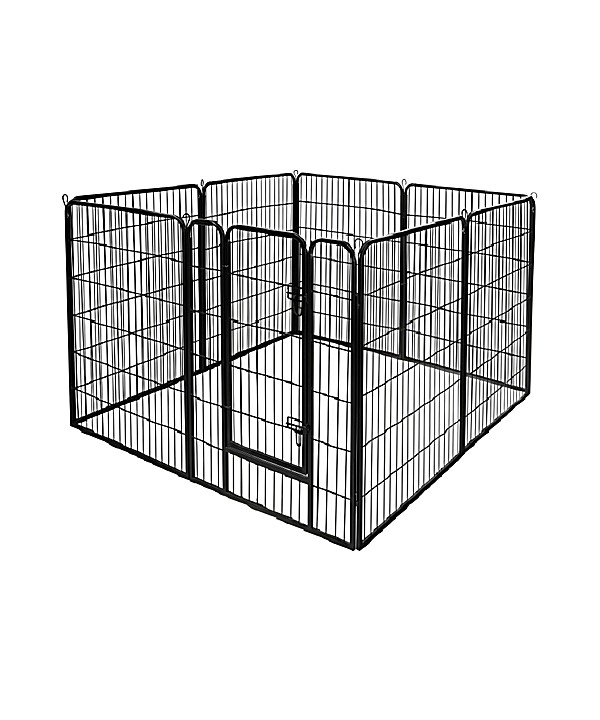
A modular playpen such as KY-P0048 shows why the packaging and tolerance points carry equal weight, because its value to a retailer is the flat carton as much as the panels — a millimetre of extra thickness or a loose hinge tab turns a shelf-ready box into a damaged return. Agreeing both, before the run, is what keeps the first shipment sellable.
Related products

Sourcing pet cages for your market? Send us the model and quantity — we reply within one working day.
Request a Quote