
How Wire Diameter and Tube Thickness Affect Cage Costs
Two cages can look identical in a catalogue photograph and still differ by a wide margin in landed cost, because the money sits in wire weight, weld time and carton volume rather than in the shape. Before comparing quotes, standardise those three numbers — otherwise you are comparing a specification, not a price.
Most sourcing projects begin with three or four quotations that appear comparable because the photographs are comparable. They usually are not. One supplier quoted 3.0 mm wire on a 0.8 mm tube frame, another quoted 3.8 mm wire on a 1.2 mm tube, and neither figure appears on the quotation sheet. The gap is not margin. It is material, labour and freight, and it is decided long before the price is typed into an email.
Where the money actually sits
Material is normally the largest single line. Wire and tube are bought by weight, and weight scales with the square of the diameter: moving from 3.0 mm to 3.8 mm wire increases the steel in every bar by roughly 60 percent, not 27 percent, because both the width and the depth of the section grow. A cage that looks only slightly heavier on a spec sheet can carry a materially different steel bill.
Welding is the second line, and the one buyers most often overlook. Every intersection on a wire grid is a weld, and the count rises quickly with bar spacing: tightening spacing from 25 mm to 20 mm adds welds across the whole panel, not just along one edge. Labour, electrode or gas consumption and inspection time all move with that count. A cheap quote that thins out the welds is not a cheaper process — it is a shorter one.
Coating, packaging and freight make up the rest. Coating cost follows surface area more than weight, so a larger cage with thinner wire can cost more to finish than a smaller, heavier one. Packaging follows volume, and volume is where thick wire quietly becomes expensive: a heavier frame needs a stronger carton, and a bulkier one fills a container faster. Freight is charged on space, so a cage that gains 5 mm in every direction can lose a whole layer of cartons per pallet.
Why a thicker tube is not automatically a stronger cage
Buyers often solve a flexing problem by asking for a thicker tube everywhere. That works, but it is the expensive way to do it. Stiffness depends on where the material sits as much as how much there is, so a slightly larger section with the same wall thickness usually outperforms a thicker wall on the same section — and it does so without adding the same weight.
The practical question is not "how thick" but "which parts carry the load". On most cages that means the base frame, the uprights at the corners, and the hinge side of the door. Those are the places where deflection shows up first, and they are also the places where extra material changes what the customer feels when they lift the cage or open the door. Adding wall thickness to a decorative top rail costs money and changes nothing.
There is a commercial side to this as well. Weight affects how a retail customer lifts the box, how a shelf carries the stock, and what a return costs if the cage arrives bent. A specification that is heavy in the wrong places buys neither durability nor a better unboxing experience; it just adds freight.
Building a rough cost model before you ask for quotes
You do not need a factory cost sheet to sanity-check a quotation. Three ratios are enough. Weight per unit tells you whether the steel bill is plausible: multiply the total wire length by the cross-section area and the density of steel, and you have a number the factory cannot argue with. Weld count tells you whether the labour is plausible: count intersections per panel and multiply by the number of panels. Carton volume tells you whether the freight is plausible: divide the container's usable volume by the carton size.
With those three numbers you can compare suppliers who quoted differently, and you can spot the quote that is too low to be real. A price that is well below the others on the same drawing usually means one of three things: thinner wire than stated, fewer welds than the drawing requires, or a carton that will not survive the container. Each of those is a cost you will pay later instead of now.
How to compare quotes that use different specifications
Ask every supplier to quote against one written specification: wire diameter in millimetres, bar spacing, frame tube size and wall thickness, coating type, and carton dimensions. A supplier who cannot state these on a drawing is not quoting the same product, however similar the photograph looks.
Then compare on three derived numbers rather than on price alone. First, total steel weight per unit — most factories can give you this from the drawing. Second, weld count per panel, which tells you how much labour is really in the cage. Third, carton volume, which decides how many units fit a container and therefore what you actually pay to move them. Quotes that look 8 percent apart often come out level, or inverted, once these three are on the table.
Finally, decide which differences you are willing to pay for. A heavier base frame on a cage that will be moved daily is worth money. A thicker top rail on a cage that hangs on a wall is not. A flat-pack design that folds may cost more to weld but saves enough container space to beat a rigid frame on landed cost, which is why the folding configuration is worth pricing both ways before the order is placed.
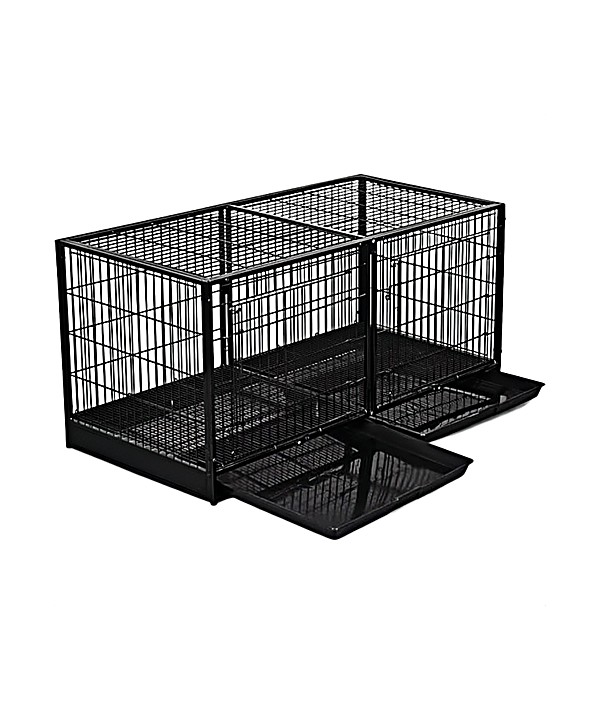
A large multi-tier cage such as KY-P0014 shows how these decisions compound, because its frame carries three tiers of load and its carton is the single biggest driver of its freight. For that kind of unit, wire diameter, tube section and packaging should be agreed together on one drawing — and the sample should be checked against all three before mass production starts.
Related products
Sourcing pet cages for your market? Send us the model and quantity — we reply within one working day.
Request a Quote