
Plastic Tray or Metal Tray in Dog Crates
For most dog crates, a plastic tray is the better choice for light use and easy cleaning, while a metal tray is the better choice for heavy chewers and long term use. The right choice depends on the dog, the market and how often the tray will be removed and cleaned, not on the price of the tray alone.
The tray is the part of the crate that a buyer often overlooks, and it is the part that an owner touches every day. It catches waste, water and food, it slides in and out for cleaning, and it takes the weight of the dog when the dog lies down. A tray that cracks, warps, rusts or does not fit will cause a return even when the wire frame is perfect, because the owner cannot use the crate without a tray that sits flat and slides smoothly. A buyer who chooses a tray only by its unit price will miss the cost of replacements, the cost of cleaning and the cost of returns, and those costs often decide which tray is cheaper in the end.
How plastic and metal trays differ in daily use
A plastic tray is light, quiet and easy to handle. It slides in and out without much effort, it does not rust, and it can be wiped clean with a damp cloth and dried quickly. For a small or medium dog that does not chew, a plastic tray is usually enough, and its light weight makes the whole crate easier to lift, to move and to ship. A plastic tray also feels warmer to the touch than a metal tray in a cold room, and it does not make a loud noise when a dog moves on it.
The weakness of a plastic tray is that it can crack, scratch and warp. A heavy dog can bend a thin tray, a puppy can chew the edge, and a tray that is left in the sun or near a heater can lose its shape. Scratches on the surface can hold odor and stains, even after cleaning, and a deep scratch can become a place where bacteria can grow if the tray is not cleaned and dried fully. A cracked tray cannot be repaired in a shop, and it must be replaced, so a buyer should check the thickness and the edge strength on the sample before ordering.
A metal tray is heavier and stronger, and it resists chewing, scratching and warping far better than a plastic tray. For a large dog, a strong chewer or a dog that will use the crate every day for a long time, a metal tray will usually last longer. It can be wiped clean, it does not hold odor in the same way, and it keeps its shape when a heavy dog lies on it. The weakness of a metal tray is that it can rust if the coating is damaged, it can be noisy when a dog moves, and it can feel cold in winter. Its edges must be smooth, because a sharp edge on a metal tray can injure a paw. A metal tray is also heavier, so it adds weight to the whole crate and to the shipping cost.
What each tray costs over time not at purchase
At the point of purchase, a plastic tray usually costs less to make than a metal tray. The material is lighter, the forming is simpler, and the tray does not need welding or a coating line in the same way. A metal tray needs more material, more work to cut and fold the sheet, and a coating to protect it from rust, so its first cost is higher. A buyer who only looks at that first cost will usually choose plastic, but that choice can be more expensive over time if the tray has to be replaced.
The real cost includes replacements, cleaning time and returns. A plastic tray that cracks in shipping or that is chewed in the first month will need a replacement tray, and that replacement has to be sent, fitted and explained to the customer. A metal tray that rusts because its coating was damaged in transport will also need a replacement, or it will come back as a return. A tray that is hard to clean will take more time for the owner, and a tray that does not fit will be returned even when the frame is fine. This depends on the specification and needs confirmation against the drawing, including the tray material, the tray thickness, the edge finish and the fit in the frame.
For a market that sells mainly to owners of small dogs, a plastic tray is often the lower total cost, because the dogs are light, the trays are rarely chewed, and the trays are easy to replace. For a market that sells mainly to owners of large dogs, a metal tray is often the lower total cost, because the trays last longer and the number of replacements is lower. A buyer should not decide by the tray price alone. The buyer should decide by the dog, by how the crate will be used, and by how many trays are likely to come back.
How to check a tray before you approve a sample
Do not approve a tray from a photo. Take the sample, slide the tray in and out several times, and check that it moves smoothly without catching on the frame. Lift the tray out, put it back, and check that it sits flat on the base with no gap at the corners. Press gently on the center of the tray and on the edges, and check that it does not bend, flex or make a cracking sound. Run a finger carefully along the edges and the corners to feel for sharp points, rough spots or thin areas.
Then test the tray as an owner would. Pour a small amount of water on the tray, wipe it clean, dry it fully, and check that no water stays in a corner or under an edge. Check that the tray can be cleaned with a damp cloth and that it dries quickly, because a tray that stays wet will hold odor and will rust if it is metal. Check the fit again after cleaning, because a plastic tray that warps when wet and a metal tray that swells at a damaged coating will not fit the same way after the first clean. If the tray is plastic, look for a smooth surface without deep scratches. If the tray is metal, look for an even coating without bare spots, chips or white marks.
Ask the supplier to state the tray material and the tray thickness on the drawing, and to confirm how the tray is made and how its edges are finished. Ask whether a replacement tray is available, and how it is packed, because a buyer who cannot supply a replacement tray will lose a sale when a tray is damaged. A tray that is easy to replace is a tray that causes fewer returns, even when it is damaged in use.
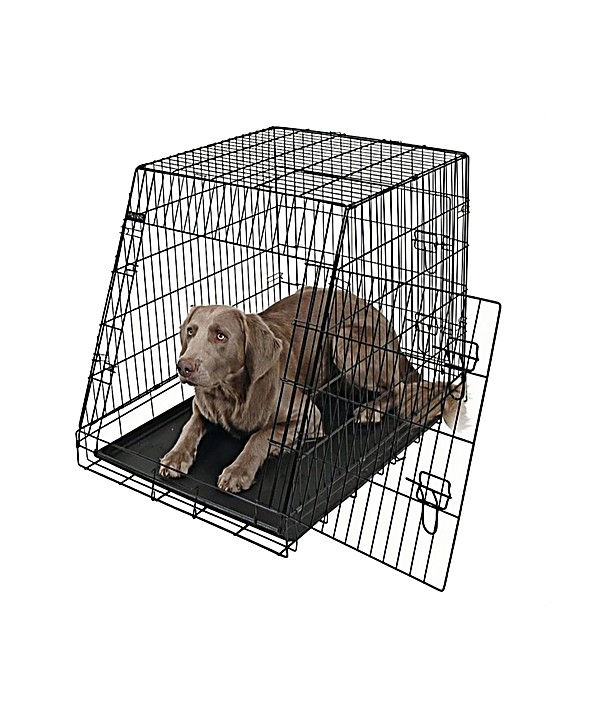
A sloped front wire dog crate like KY-P0036 shows why this matters in practice, because its plastic tray and sloped front are made to fit in a car and to be removed and cleaned often. For that kind of crate, the buyer should confirm the tray fit, the tray thickness and the edge finish together, and approve the sample only when the tray slides smoothly and sits flat after cleaning. We build to the drawing, with MOQ 500 pcs and a lead time of 35 days, and a change to the tray material counts as a specification change.
Related products
Sourcing pet cages for your market? Send us the model and quantity — we reply within one working day.
Request a Quote