
How to match a dog crate size to breed and to your market
The right dog crate is the smallest size that still lets the dog stand, turn around and lie down stretched out. If you choose by breed name alone, you will order the wrong size, because dogs of the same breed vary in height, length and weight, and your market may need a different size range than another market.
Size is not a detail that can be fixed later with a different tray or a different door. A crate that is too small makes a dog uncomfortable, and an uncomfortable dog is a return and a complaint. A crate that is too large is not safer. For house training, a large empty space lets a puppy use one corner as a toilet and sleep in another corner, which defeats the purpose of the crate. For transport and storage, a large crate takes more space in a car, in a warehouse and on a shop shelf, and it costs more to ship for no added benefit.
Measure the dog first and then choose the crate
Start with the dog, not with a size chart. Measure length from the tip of the nose to the base of the tail while the dog is standing, and measure height from the floor to the top of the head or the top of the ears, whichever is higher. Weigh the dog as well, because two dogs of the same length can have very different builds, and a heavy dog needs a stronger frame even if the length is the same. Write down all three numbers before you look at any crate, because a size that looks right for length can still be wrong for height.
Then add a small allowance so the dog can move, but do not add too much. As a starting point for discussion, add enough length for the dog to lie down with legs stretched out, and enough height for the dog to stand without touching the roof with its ears. That allowance depends on the breed and on the way the crate will be used, and it needs confirmation against the drawing, because a puppy will grow and an adult dog will not. For a puppy, many buyers choose a size that fits the adult dog and use a divider to keep the space small while the puppy is young, which avoids buying a second crate later.
Always check interior dimensions, not exterior dimensions. The exterior size includes the frame, the feet, the latch and the tray handle, and it can be several centimeters larger than the space the dog can actually use. Ask the supplier to state interior length, interior width and interior height on the drawing, and check the door opening as well, because a dog that fits inside the crate may still struggle to enter through a narrow door. A large dog needs a wide door and a low threshold, while a small dog needs a door that closes firmly and cannot be pushed open from inside.
Match the crate to breed size and to daily use
Breed groups are useful as a starting point, but they are not a rule. Small breeds such as Chihuahua, Pomeranian, Toy Poodle, Dachshund and Shih Tzu usually need a compact crate that fits in a small room or in the back of a car. Medium breeds such as Beagle, Cocker Spaniel, Border Collie and Bulldog need more length and height, and they are often strong enough to test a latch, so the door and the welds matter as much as the size. Large breeds such as Labrador, Golden Retriever, German Shepherd and Boxer need a crate that is long, tall and stable, with a frame that does not flex when the dog moves. Extra large breeds such as Great Dane, Mastiff and Saint Bernard need the largest size, with a wide door.
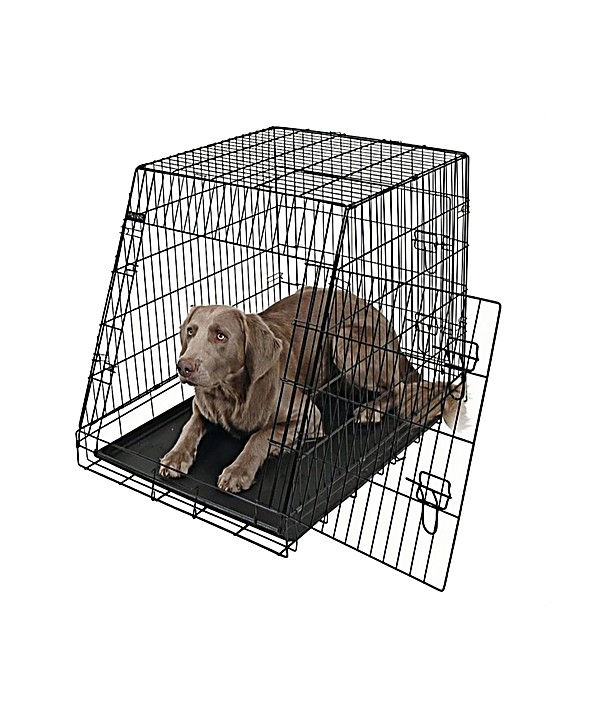
Daily use changes the size you need. A crate for house training should be snug, with just enough room to stand, turn and lie down, so the dog learns to treat the crate as a sleeping place. A crate for travel should fit the car, and a sloped front can help it fit in a hatchback or on a rear seat. A crate for a vet clinic, a boarding kennel or a grooming shop needs to be easy to clean, with a tray that slides out without lifting the dog, and a door that opens fully so staff can reach the dog quickly. A crate for home use needs to fit the room where it will stand, and a folding crate can be stored flat when it is not in use, which matters in a small apartment.
Turn one size into a range your market can sell
A wholesale buyer does not order one crate. The buyer orders a range, and the range should cover the breeds that sell in that market without creating too many slow lines. A common starting range is four sizes, small, medium, large and extra large, with the middle two sizes forming the core of the order. That range covers most pet dogs, from a small companion dog to a large family dog. If your market is mainly small apartments, you may need more small and medium sizes and fewer extra large sizes. If your market is mainly houses with gardens and large cars, you may need more large sizes.
Check the breeds that are popular in your market before you fix the range. Look at which breeds your customers already buy food, beds and leads for, and look at which breeds are common in local vet clinics and pet shops. Look at housing as well, because a market with small flats will not sell many extra large crates, even if the breed is popular. Look at retail space too, because a shop with limited floor space will prefer a range that stacks or folds, and a warehouse with limited shelf height will prefer a range that packs flat. A range that fits your market will sell through faster and will come back less often, because the customer can find a size that fits both the dog and the home.
Test the range with samples before you commit to a large order. Order samples of the middle sizes first, measure the interior dimensions with a tape measure, put a real dog of the target breed inside, and check that the dog can stand, turn and lie down without touching the sides. Open and close the doors several times, slide the tray in and out, lift the crate by the top and check that the frame stays rigid. Ask retail customers which size they would choose, and note where they hesitate.
A folding crate like KY-P0038 shows why this matters in practice, because its flat folding design and plastic base tray make it easy to store, to ship and to display in a shop, while still giving the dog a clear space to rest. For that kind of crate, the buyer should confirm the interior size, the door size and the folded size together, and approve the sample only when all three match the drawing. We build to the drawing, with MOQ 500 pcs and a lead time of 35 days, and a change of size counts as a specification change. That single check, done before production, prevents most of the problems that appear later as wrong sizes, slow stock and returns.
Related products
Sourcing pet cages for your market? Send us the model and quantity — we reply within one working day.
Request a Quote